Article
How to Tell If Your SEO Company Is Working
Check whether your SEO agency is earning its fee. The numbers to pull yourself, the questions Google says to ask, and what an honest report looks like.

Ignore the website traffic chart. For a local business, open your Google Business Profile Performance tab and check calls, direction requests, and the search terms people used to find you. If most of those terms are your own business name, your agency is harvesting customers you already had, not winning new ones.
We are an agency. Writing a guide on how to catch a bad agency is an odd thing for us to do, so everything below is either something you can check yourself in an afternoon, or something Google published. Near the end we hand over our own client reports and show you the parts of them that make us look worse.
How to Tell If Your SEO Company Is Working: The Five-Minute Version
Log in and answer four questions. You do not need your agency’s permission for any of this.
- Open your Google Business Profile Performance tab. Are calls and direction requests higher than the same months last year?
- Look at the search terms. Are people finding you by what you do, or only by your name?
- Count your reviews. How many arrived in the last 90 days, versus the 90 days before you hired anyone?
- Ask your phone. Do you know how many calls came in last month? An actual number?
If you cannot answer those, that is not your fault, but it is the problem. Everything after this is how to fix it.
Why Is Website Traffic the Wrong Number for a Local Business?
Because most of your customers never reach your website, so a flat traffic chart tells you almost nothing.
This is the assumption sitting underneath nearly every article on this topic, and it is imported wholesale from ecommerce. Someone searches “plumber near me”, the map pack appears, they tap the call button. That customer converted without loading a single page of your site. Your agency’s traffic chart cannot see them, and neither can Google Analytics.
So a local business can have a flat traffic line and a busier phone, or a rising traffic line and a dead phone. Traffic is a proxy for a thing you do not sell.
That does not make website work pointless. It makes website sessions the wrong headline metric. The right ones are on a different screen entirely.
What Does the Google Business Profile Performance Tab Actually Show?
It shows the interactions your profile produced, and it is free, first-party, and yours.
Google documents each metric, and the exact wording matters more than you would think:
| Metric | What Google says it counts | What it is worth |
|---|---|---|
| Calls | ”The number of times a customer clicked on the call button” | Intent. Not a conversation. |
| Directions | How many people asked for directions | Strong intent for anyone with a door. |
| Website clicks | Clicks on the website link | The bridge to your site. |
| Searches | ”The search terms people used to find your business” | The most useful screen in the whole tab. |
| Views | Unique people who viewed your profile | Less than you think. See below. |
Two traps worth knowing, both straight from Google’s documentation.
Calls are button taps, not conversations. When an agency reports “142 calls”, they are reporting 142 taps. How many were answered, how many were wrong numbers, and how many turned into work is not in that number.
Views is not a visibility metric. Google spells this out: “This metric only counts the views of your Business Profile and not the overall views of your business on Google.” It also counts a person once per day no matter how many times they look. So Views is not how often you showed up in results, and it never was.
The Searches list is the one to spend your time on. It is updated monthly and it tells you which words are bringing people in. If the list is dominated by your own business name, those are people who already knew you existed. Growth looks like unbranded terms climbing that list: the trade, the problem, the neighborhood. That is the difference between an agency winning you new customers and an agency taking credit for your reputation.
Keeping that profile earning is exactly what our Google Business Profile management service does, and the Performance tab is the report we are judged on too.
Is Your Map Pack Ranking Real, or Cherry-Picked?
Any single ranking screenshot is close to meaningless, because local rank changes with where the searcher is standing.
Google names three things that drive local results: relevance, distance, and prominence. Distance means exactly what it says: “how far each business is from the customer who’s searching.”
Think about what that hands an agency. Stand next to your shop and search your trade, and you will look terrific. Move two miles and you may vanish. A screenshot of a number one ranking, with no location attached, is not evidence. It is a photograph taken from a spot the agency chose.
The honest way to measure this is a grid. You run the same search from dozens of mapped coordinates across the area you actually serve, and you get a picture of where you show up and where you do not. The summary number people use is Share of Local Voice: the share of those checkpoints where you land in the top three. It is a useful instrument, and it comes with a catch nobody mentions.
While you are at it: Google is blunt that “there’s no way to request or pay for a better local ranking on Google”, and that “Google doesn’t evaluate or endorse third-party SEO tools, and these tools don’t have access to Google’s internal ranking data”. No rank number from any tool, ours included, comes from Google. Every one of them is a model of what Google probably showed somebody. Treat them as instruments with a stated method, never as ground truth. Any agency presenting rank data as fact is overselling what the data is. That is the honest version, and it applies to our grids too.
Are Your Reviews Actually Growing?
Reviews are the easiest deliverable in this whole business to audit, and almost nobody does it.
You do not need a tool. Open your profile and count. Three numbers, and you can get all three in ten minutes:
- Velocity. New reviews in the last 90 days, against the 90 days before the engagement started.
- Response rate. What share have a reply from you? And how fast?
- Rating trend. Where was the star average when you signed, and where is it now?
Reviews are also one of the few things on your profile that Google explicitly connects to local ranking: “More reviews and positive ratings can help your business’s local ranking.” Note the hedge. Google said “can help”, so we will not upgrade it to a promise.
One thing to watch for that looks like performance and is actually a liability. If your agency is filtering review requests so only happy customers get asked, that violates Google’s content policy, which prohibits merchants from “selectively solicit[ing] positive reviews from customers”. So does asking customers to mention a particular service or town in their review. Requests go to every customer, unfiltered and unscripted, or they are a risk you are paying someone to take on your behalf. That is how our reputation management works, and it is the only way that survives contact with the policy.
Is Anybody Actually Counting Your Phone Calls?
Probably not, and for most local businesses the phone is the entire business.
This is the strangest gap in the published advice on this topic. Every article measures form fills and ecommerce checkouts. For a plumber, a clinic, or a law firm, the conversion is a phone call, and it usually happens from the map pack without ever touching a website. Google Analytics cannot see it. Your agency’s dashboard cannot see it.
You want two numbers your agency almost certainly is not giving you: how many calls came in, and how many turned into work. A tracking number, or even a disciplined note by the phone, closes the gap between “142 taps on the call button” and “eleven jobs booked”.
Which one do you think should be on page one of the report?
Do ChatGPT, Gemini, and Copilot Name You?
Nobody knows unless somebody checks, and checking takes an hour a month.
There is no dashboard for this. Your agency does not have secret access, and neither do we. What exists is a repeatable method: a fixed set of customer questions, asked across the three assistants on the same date every month, recording whether you got named. We wrote the whole thing up in SEO vs AEO vs GEO, and it is deliberately simple enough to run without us.
The accountability question is the one that belongs here. If you are being charged for AI visibility, ask for three things:
- The prompt list. If nobody can show it to you, there isn’t one.
- The result per prompt, per engine, with a date. Named, linked, or absent.
- The same for your two nearest competitors. Your own number means nothing on its own.
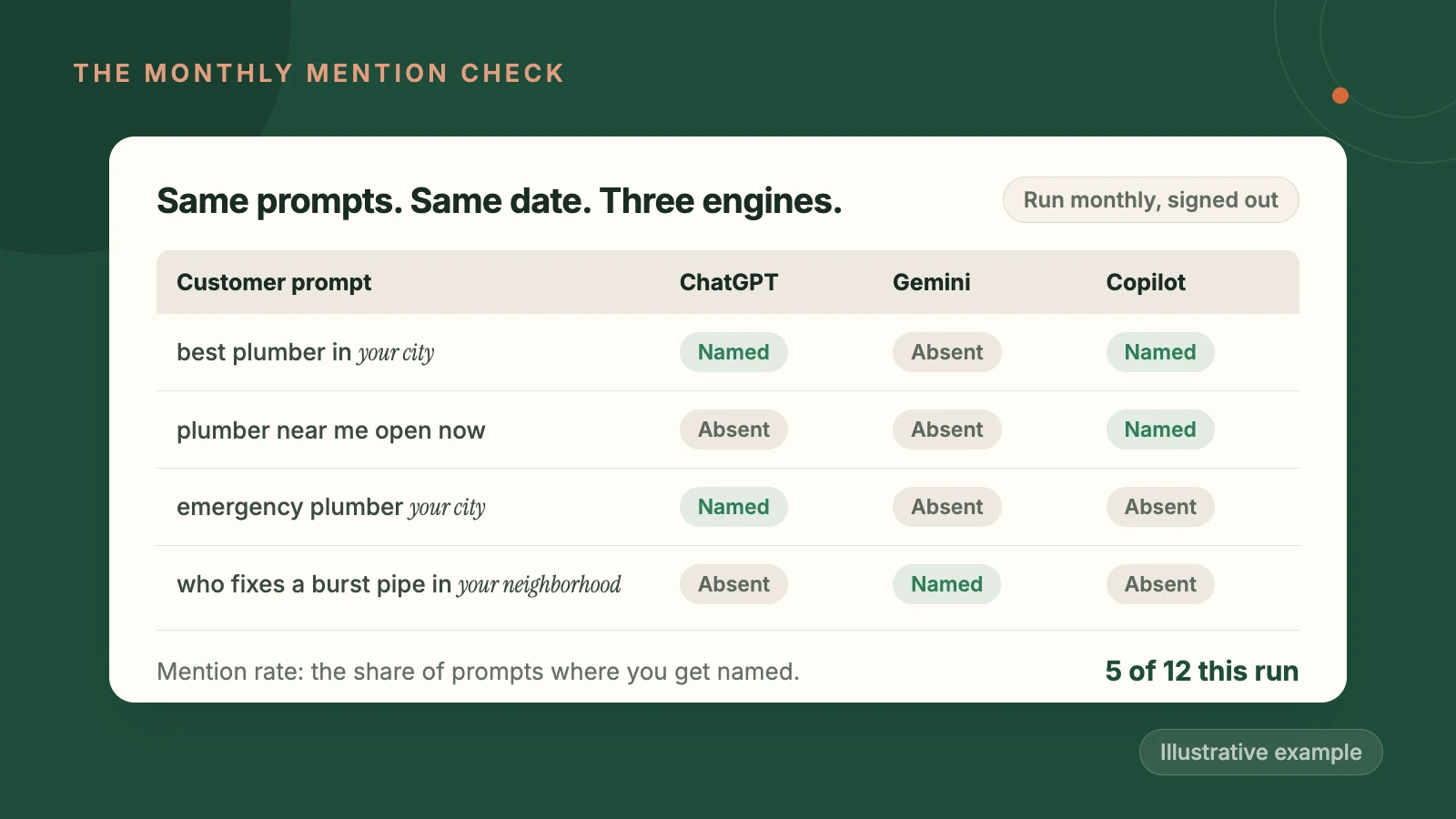
If what comes back is a screenshot of one lucky answer, you are buying a feeling. When we run this as part of AI search optimization, the prompt list is the client’s to keep and re-run, with us or without us.
Google, for what it is worth, now lists “optimizing for generative AI” among the services an SEO can usefully provide. It is a legitimate line item. It is not a legitimate line item without a number attached.
Is Your Agency Failing, or Is SEO Just Slow?
The honest answer is that both are common, and there is a way to tell them apart.
“It takes six months” is true. It is also the single most useful sentence a bad agency owns, because it buys another quarter every time it gets said. The way through is to stop arguing about the six months and look at whether the leading indicators have moved at all.
Things that should move early, within the first month or two:
- Profile impressions and searches
- Unbranded terms appearing in the Searches list
- Review velocity
- Calls and direction requests, at least a little
Things that legitimately take longer:
- Map pack position across a whole grid
- Revenue
If the early list is moving and the slow list is not, that is SEO being slow. Keep going. If nothing on the early list has moved in three months, “it takes six months” is not an explanation, it is a delaying tactic. The difference is that leading indicators respond to work, and if no needle has twitched anywhere, the likely reason is that there was not much work.
There is a third possibility, and a fair agency will raise it before you do: the market moved. Google lists seasonality among the causes of organic traffic drops, and recommends checking the query in Google Trends to see whether the dip is yours or everybody’s. That takes two minutes and it cuts both ways. It catches agencies blaming an algorithm for winter, and it catches agencies claiming credit for spring.
Why Do Rankings and Reports Disagree With What You See?
Because there is no single ranking, and Google says so.
If you have ever searched your own keyword, seen yourself in position eight, and then been handed a report claiming position five, neither party is necessarily lying. Google documents that the position in Search Console is an average, and that “for your specific search your position might be different than the average because of many variables, such as your search history, location, and so on.”
Two more limits worth knowing before you accept any Search Console screenshot as complete:
- Rare searches are hidden. Google omits queries “that aren’t issued by more than a few dozen users over a two-to-three month period”, as its Search Advocate Daniel Waisberg explains in detail. For a local business those hidden queries are precisely the long-tail neighborhood searches you care about most.
- The data is late. Google says performance data is “usually available in 2-3 days”, and the newest days are preliminary. A report emailed on the 1st cannot contain complete data through the 30th.
And when a report credits SEO with a conversion, know what that claim rests on. GA4’s default is data-driven attribution, which spreads the credit across touchpoints using Google’s own modelling. You cannot audit it. Neither can your agency.
If the property has been switched to last click instead, Google describes that model as one that “Ignores direct traffic and attributes 100% of the key event value to the last channel that the customer clicked through (or engaged view through for YouTube) before converting.”
Read the first three words again. A customer who saw you in the map pack in March, thought about it, then typed your name straight into Google in May gets credited to nobody at all.
The number in the report is a modelling choice before it is a measurement. Ask which model produced it.
What Does an Honest Report Look Like?
It states its window, its data source, its method, and what it cannot prove. Here is ours, including the parts that undercut our own headlines.
Every case study we publish carries a section called How We Measured These Results, with those four fields. It is not marketing. It is the receipt, and you can read all of them without talking to us.
Our plumbing client’s headline is a 223% increase in calls. Here is the limitation we print underneath it:
Percentages compound from a small base: a quiet phone at the start makes early relative gains look steep, which is why we publish the grids alongside the percentages.
That sentence tells you our best number is flattered by a quiet starting point. We wrote it about ourselves, and it is on the plumbing case study right now.
Our chimney sweep client’s Share of Local Voice went from 0% to 94%, the most dramatic number we have. Underneath it:
Chimney work is strongly seasonal (the window ends entering inspection season), so some of the call growth rides demand as well as visibility.
Some of that growth was the calendar, not us. That is on the chimney sweep case study.
And from the self storage case study, on a short engagement:
Eight weeks is a short measurement window; it demonstrates direction and pace, not a settled end state, and spring is also a stronger rental season.
We are not showing you these to look humble. We are showing you the shape, because the shape is the point, and you should demand it from whoever you are paying:
| Field | The question it answers | What to ask for |
|---|---|---|
| Window | What exact dates does this cover? | Does the chart cover the same dates as the claim? |
| Data source | Where did this come from? | Can I log into that account myself and see it? |
| Method | How was it measured? | What keyword, what grid, would a re-run reproduce it? |
| Limitations | What else could explain this? | If this section is empty, it is not a report. |
That last row does the most work. A report with no limitations section is not being confident, it is being incomplete. Every number in this business has a rival explanation, and an agency that cannot name the rival explanation for its own results has not looked for one.
Hold the report you got last month against that table. If three of the four rows are missing, you are not being reported to. You are being marketed to.
Who Actually Owns Your Google Business Profile?
Check today, because this is the trap that turns a bad engagement into an expensive one.
The standard advice is to make sure you have access to your analytics. True, and not the local version. The local version is worse:
- Your profile. Are you the owner, or a manager? If your agency is the primary owner, they can remove you. Google is explicit that “you have the right to know your profile’s performance” and that third parties “can’t promise nor directly influence your business’s ranking on Google Search or Maps through any special means”.
- Your domain. Is it registered to you, or to them?
- Your phone number. If your tracking number is on your trucks and your signage, and the agency owns it, leaving costs you a rebrand. Nobody thinks about this until they try to leave.
Google’s own guidance for working with third parties on your profile is worth reading in full before your next renewal. It also recommends working with one third party at a time, since your business can only appear once on Google, which quietly explains why “we will run a test alongside your current agency” rarely produces a clean answer.
What Should You Ask Your Agency?
Google wrote the list. That is not a rhetorical flourish, it published one.
In its own document on hiring an SEO, last updated in June 2026, Google recommends asking:
- “Can you show me examples of your previous work and share some success stories?”
- “What kind of results do you expect to see, and in what timeframe? How do you measure your success?”
- “What’s your experience in my industry?”
- “What’s your experience in my country/city?”
- “Will you share with me all the changes you make to my site, and provide detailed information about your recommendations and the reasoning behind them?”
Google also draws a hard line on guarantees: “No one can guarantee a #1 ranking on Google. Beware of SEOs that claim to guarantee rankings, allege a ‘special relationship’ with Google, or advertise a ‘priority submit’ to Google.” And on audits specifically: “If they guarantee you that their changes will give you first place in search results, find someone else.”
Four more, for a local business, that an enterprise playbook cannot answer:
- Show me the search terms in my Performance tab. Which unbranded ones grew?
- Show me the grid, with its size and radius, and the same grid from last quarter.
- How many reviews arrived last month, and what share got a reply?
- Which prompts did you test in ChatGPT, Gemini, and Copilot, and was I named?
If those get answered with a traffic chart, you have your answer.
The Uncomfortable Part
Most agencies are not scamming you. Most are reporting activity because activity is easy to report and outcomes are hard.
Twenty blog posts published. Forty citations built. Weekly posts posted. All true, all verifiable, all silent on whether your phone rang more. Google’s own hiring guide asks the question that cuts through it: “How do you measure your success?” If the answer is a list of things done rather than things changed, that is the finding.
You do not need to become an SEO to catch this. You need the Performance tab, a review count, and a phone that gets answered.
Rather have someone read all of it with you? A free local audit is 20 minutes: we pull your profile data, run the AI prompt set live, and tell you what your current setup is actually producing. If your agency is doing well, we will say so.
Isaac founded Localplus to help local businesses in the US, UK & Canada get found in AI searches like ChatGPT, Gemini and Copilot. He's been working in the SEO space for over 15 years.