Article
SEO vs AEO vs GEO: What Each One Means for a Local Business
SEO, AEO, and GEO explained for local businesses, without the hype. What each term actually means, where AI really gets its answers, and what to fix first.

SEO is getting found in a list of search results. AEO is being the short direct answer a search engine lifts and shows. GEO is being named inside an AI answer from ChatGPT, Gemini, or Copilot. For a local business the three overlap almost completely, and Google says optimizing for AI is still SEO.
That last part is going to cost somebody a sale, so let me be clear about who is saying it. Not us. Google, in its own documentation, updated five days before this guide went out.
This guide covers what the three acronyms mean, which parts of the distinction are real, and the part almost nobody writes about: where an AI assistant actually gets its answer when somebody asks it for a plumber in your town. It is not your blog.
What Do SEO, AEO, and GEO Actually Mean?
They are three names for getting found, aimed at three different shapes of search result.
SEO is search engine optimization: earning a spot in the ranked list of results, and the click that comes with it. It is the oldest of the three and the only one with thirty years of practice behind it.
AEO is answer engine optimization: being the source a search engine lifts to answer a question directly, in a featured snippet or a voice answer, usually without a click.
GEO is generative engine optimization: being named or cited inside an answer an AI writes for someone, in ChatGPT, Gemini, or Copilot.
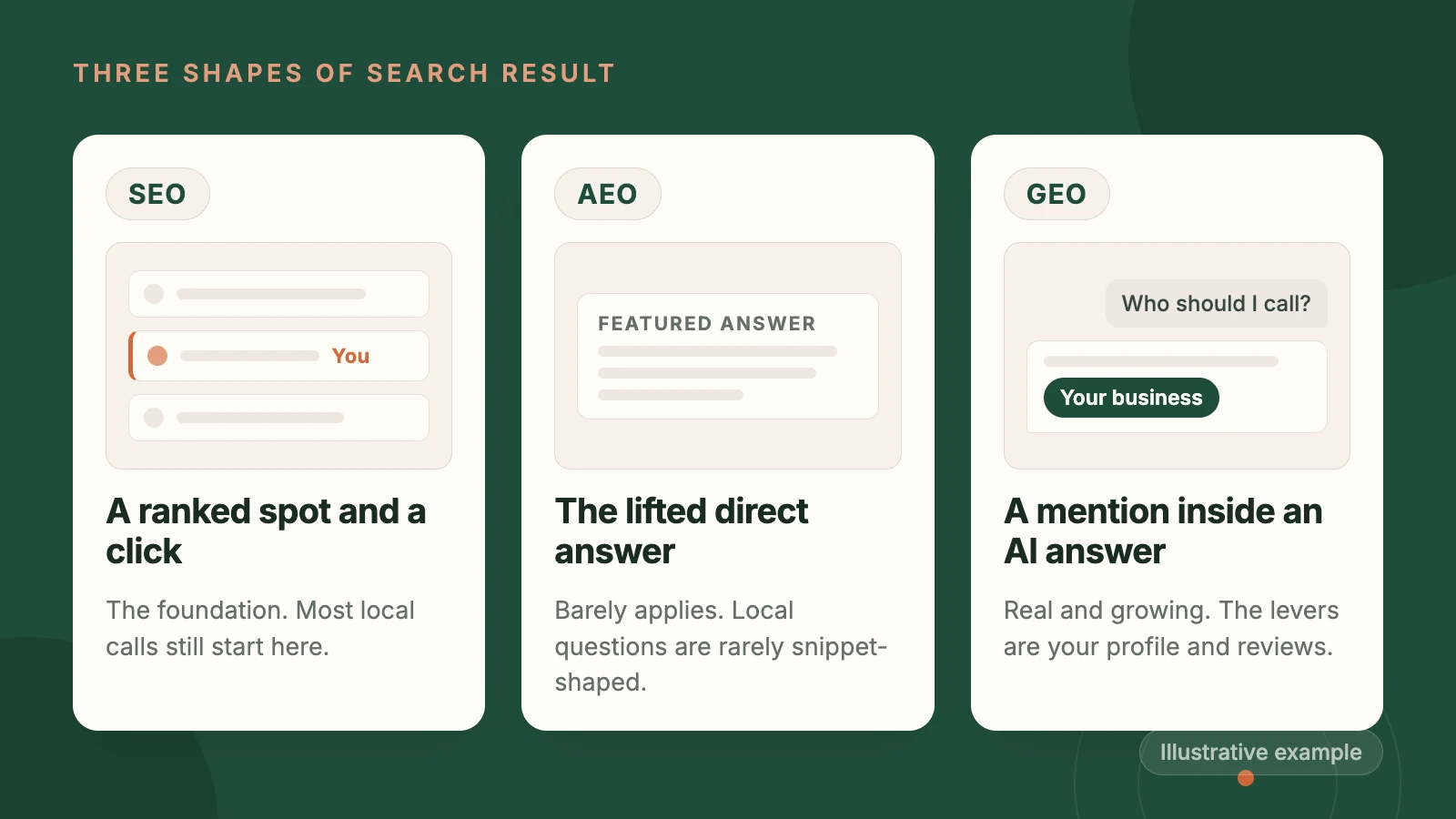
Here is the part the comparison articles leave out. That fourth column is the whole reason this guide exists.
| Term | What you are trying to win | Who invented it | What it means if you are a local business |
|---|---|---|---|
| SEO | A ranked spot and a click | The industry, in the 1990s | The map pack and your service pages. Still where most of your calls come from. |
| AEO | The lifted direct answer | Marketing vocabulary, no formal origin | Barely applies. Nobody asks a search engine a snippet-shaped question about your shop. |
| GEO | A mention inside an AI answer | An academic paper, 2024 | Real and growing. But the levers are your profile and your reviews, not your writing. |
Where Did GEO Actually Come From?
GEO came from a peer-reviewed research paper, which is more than AEO can say.
The term was coined in “GEO: Generative Engine Optimization” by Aggarwal, Murahari, Rajpurohit, Kalyan, Narasimhan, and Deshpande, presented at the ACM SIGKDD conference in 2024. It is a real piece of research, it is free to read, and it is the only primary source underneath the entire GEO industry.
It is also being wildly misquoted, and the misquote is easy to check.
The paper tested nine ways of changing content and measured which ones got a source cited more often. Adding quotations, statistics, and citations raised visibility. Keyword stuffing was the only method that made things worse. That finding is solid and it is genuinely useful.
The “40% more visibility” number you have seen in a hundred agency posts needs three corrections. It is the top of a 30% to 40% range, not a single figure. It came from three of the nine methods, not one. And it was measured on Position-Adjusted Word Count, a metric the authors invented for the study. It is not traffic, leads, or calls.
Does GEO Replace SEO?
No, and Google is unusually direct about this.
In its guide to optimizing for generative AI features, updated 10 July 2026, Google writes: “From Google Search’s perspective, optimizing for generative AI search is optimizing for the search experience, and thus still SEO.”
Google goes further in its AI features documentation: “There are no additional requirements to appear in AI Overviews or AI Mode, nor other special optimizations necessary.” And on the files and markup being sold as AI levers: “You don’t need to create new machine readable files, AI text files, or markup to appear in these features. There’s also no special schema.org structured data that you need to add.”
Read that twice if somebody has been quoting you for an llms.txt file.
There is one honest asymmetry worth knowing. Google says schema is not required for its AI features. Microsoft’s Bing has said the opposite about its own systems: Fabrice Canel, a principal product manager at Bing, told an SMX Munich audience in March 2025 that Microsoft uses schema markup to help its language models understand content, as reported by Search Engine Land. Two engines, two positions. Anyone who tells you the answer is settled is selling something.
Where Does AI Actually Get Its Answer About a Local Business?
From your Google Business Profile, your reviews, and other people’s pages about you. Almost never from your own website content.
This is the single biggest misunderstanding in every article on this topic, and it changes what you should spend money on.
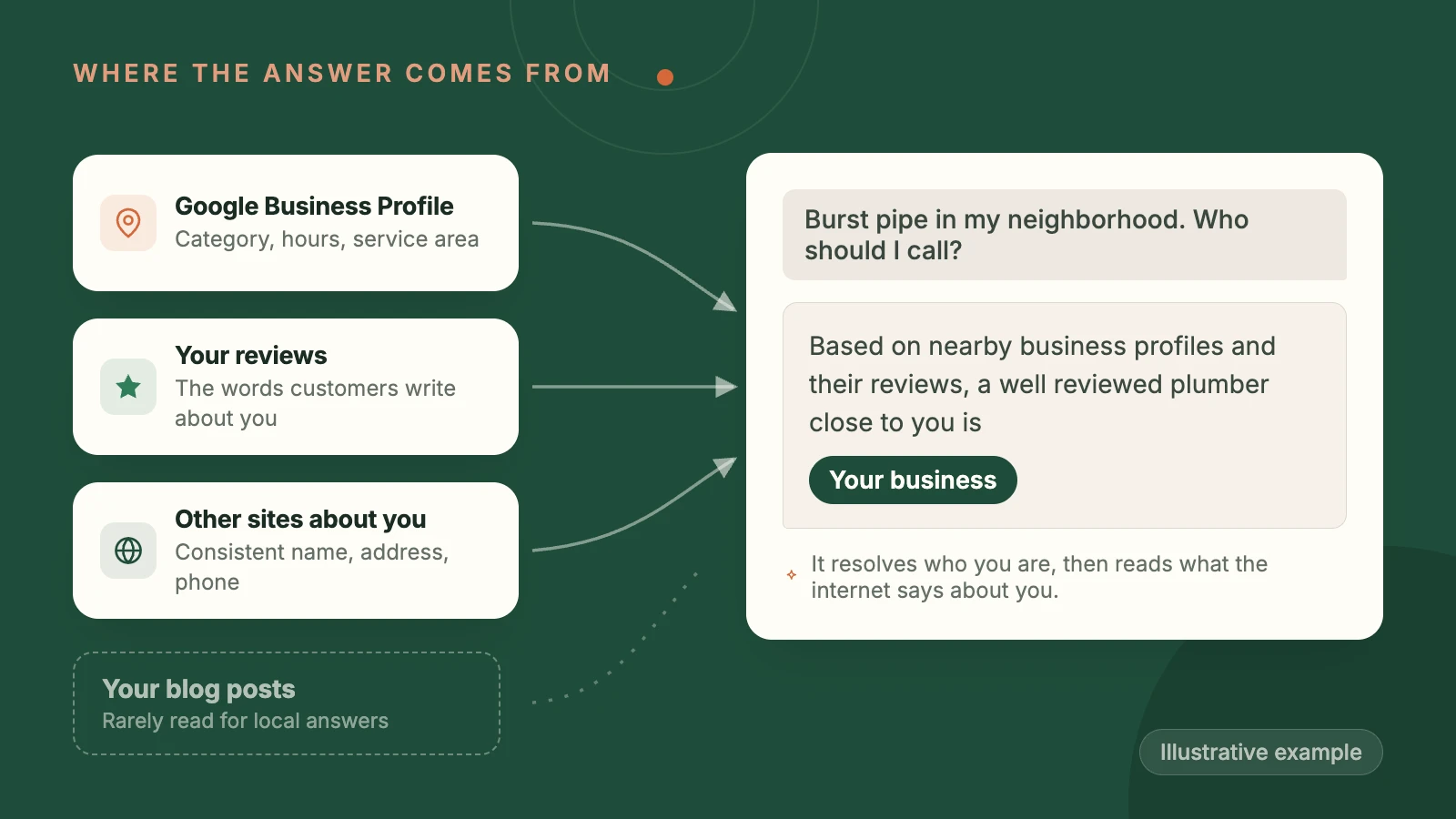
The standard GEO advice assumes one mechanic: an AI crawls your article, likes your article, cites your article. That is roughly true if you sell project management software and someone asks for the best project management software. It is not how a local recommendation works.
When somebody asks an AI assistant who to call for a burst pipe in their neighborhood, here is what each engine is actually reaching for.
Gemini. Google has built Grounding with Google Maps, which connects Gemini models to Maps data on more than 250 million places, including addresses, opening hours, reviews, and photos. Worth being precise: that is a developer API, off by default, and Google’s documentation does not describe what the consumer Gemini app does. What we can say is that Google is systematically wiring place data into AI grounding, and Google itself writes that using a Business Profile “can help your products and services to be visible in both AI responses and other Google Search results.”
Copilot. Microsoft documents that when Copilot needs the web, it writes a search query and sends it to the Bing search service, then composes its answer from what comes back. That documentation covers the Microsoft 365 version of Copilot rather than the consumer app, but it is the best evidenced engine-to-index link of the three. If Bing cannot see you, Copilot cannot recommend you.
ChatGPT. OpenAI documents a crawler called OAI-SearchBot and states that sites which block it “will not be shown in ChatGPT search answers”. That is a rare thing in this field: a concrete, first-party, checkable lever. Beyond that, OpenAI describes using “third-party search providers” in the plural and has never documented its consumer retrieval stack. Anyone stating flatly that ChatGPT runs on Bing in 2026 is repeating a claim OpenAI has not made.
Notice what is missing from all three. None of them is reading your blog post about seasonal boiler maintenance.
Is GEO the Same as Local SEO?
No, and the confusion is a genuine accident of vocabulary.
GEO here stands for generative engine optimization. It has nothing to do with geography. But “geo” has meant geographic for as long as anyone has used the word, so people reasonably assume GEO means location targeting. Search the question and you will find confident answers making exactly that mistake, comparing regional reach to neighborhood reach as though that were the distinction.
So, plainly:
- Local SEO is the work of getting found by people near you: your Business Profile, your categories, your reviews, your citations, your service pages.
- GEO is the work of getting named inside AI answers.
For a local business they are close to the same job, because the things that make an AI able to recommend you are the same things that make Google able to rank you. Which brings us to the part that actually pays.
What Actually Moves the Needle for a Local Business?
Three things, and none of them are new.
Your Google Business Profile is your structured data. Every GEO article tells you to add schema markup so machines can read your facts. For a local business you already have a machine-readable, first-party fact sheet, and it is your profile. Your category is the strongest field in it. Google states outright that “the categories you select affect your local ranking on Google”, which is the only field Google says that about. If your categories are wrong, fix that before you touch a line of JSON-LD. Our guide on how to change your Google Business Profile categories walks the exact clicks.
Your reviews are the corpus. Reviews are the largest body of text about your business that any AI will ever read, and you did not write a word of it. Not just the star rating. The words customers use, the problems they mention, the neighborhoods they name. When an AI justifies recommending someone, it is summarizing that. Google confirms reviews feed ranking too: “More reviews and positive ratings can help your business’s local ranking.” Getting more of them, from every customer, is reputation management doing its job.
Your name, address, and phone number have to agree everywhere. This is the boring one that everybody skips, and AI made it matter more, not less. If your details conflict across your profile, your site, and the directories, a model cannot confidently resolve you as one business. It will recommend the competitor it can resolve. That is the mechanical reason citation hygiene stopped being a checkbox, and it is core local SEO work.
Google publishes one list of what drives local results, and it is short. Its help page says they are “mainly based on relevance, distance, and popularity”, then defines the three: relevance is “how well a Business Profile matches what someone is searching for”, distance is “how far each business is from the customer who’s searching”, and prominence is “how well-known a business is”, which Google says is partly informed by how many sites link to you and how many reviews you have.
Two things to notice, because they matter more than the list itself. Google swaps between “popularity” and “prominence” on its own page, and it says “mainly based on”, not “entirely”. This is the only list Google publishes. It is not a complete algorithm, and nobody outside Google has one.
It is still the best test you have. Anything an agency sells you that does not ladder back to one of those three is a theory.
How Do You Measure Whether AI Recommends You?
You run the same prompts on a schedule and write down what happens. There is no dashboard for this yet, and anyone showing you one built it themselves.
Every competing article on this topic concedes the point and moves on. The honest ones say there are no webmaster tools reporting on what happens inside AI answers. The rest say tools are emerging. That is the state of the art, and it is worse than it needs to be, because for a local business this is far more measurable than for anyone else.
The reason is that your query space is small and you can write it down. A software company competing for “best CRM” faces infinite phrasings. You face maybe twenty, and you already know them:
- best {your trade} in {your city}
- {your trade} near me open now
- who should I call for {the problem you fix} in {your neighborhood}
- emergency {your trade} {your city}
That is a test set. Here is the method:
- Write the prompt list once. Ten to twenty questions a real customer would ask. Freeze it. Changing the list later destroys your ability to compare.
- Run them across ChatGPT, Gemini, and Copilot, signed out, on a set date each month.
- Record three things per prompt: were you named, were you linked, and which sources the answer leaned on.
- Count the mention rate, which is simply the share of prompts where you got named.
- Write down what you cannot see. Answers vary by the user’s location and account history, and they change without notice. A single run is an anecdote.
That is not sophisticated. It is a spreadsheet and an hour a month. It is also more rigor than the entire first page of Google currently offers on this question, and it gives you something no vendor score can: a number you built yourself, with a method you can hand to somebody else to re-run.
It is the same method our AI search optimization work reports on, and the prompt list belongs to the client. If anyone sells you an AI visibility score without telling you the prompts behind it, the score is decoration.
What Should You Actually Do About Any of This?
If you run a single-location business with no marketing team, most published GEO advice is useless to you. “Build topical authority” and “publish original research” and “ship an llms.txt file” are enterprise tasks wearing small business clothes. Ignore them.
The honest list is short and boring:
- Fix your primary category. The single strongest field, and Google says so.
- Fill your profile out completely and keep the hours true. Google says complete profiles are more likely to show up.
- Ask every customer for a review. Every one, not the happy ones. Selectively soliciting positive reviews is against Google’s policy, and it makes your review corpus a worse description of your business anyway.
- Make your name, address, and phone identical everywhere. Start with your own website and your profile disagreeing, because they usually do.
- Claim Bing Places. Copilot’s answers lean on Bing’s index, and almost nobody bothers. It is free and takes ten minutes.
- Check your robots.txt is not blocking OAI-SearchBot if you want to show up in ChatGPT’s search answers. OpenAI documents this one plainly.
Not one of those is GEO. Every one of them is the local SEO you were supposed to be doing in 2019. That is the actual finding, and it is why Google can say optimizing for AI is still SEO and not be spinning you.
Is Zero-Click Bad for a Local Business?
Usually not. This is where advice written for publishers goes wrong for you.
The zero-click panic is real, and it is correctly aimed at people whose business model is pageviews. If you run a news site and an AI answers the question your article was going to answer, you lost the sale.
You do not sell pageviews. You sell drain cleaning, or crowns, or storage units.
When somebody asks Gemini for a locksmith and Gemini names you, and they tap the number and call, you never wanted that pageview. You wanted the call. You got the call. The visit to your website was a toll booth on the way, and the toll booth closing is fine.
The thing to actually worry about is not being named. That is a different problem, and it is the one worth spending on.
SEO vs AEO vs GEO: Which Ones Are Actually Real?
Two of the three, and you will meet more of them by Christmas.
You will also run into AIO, GSO, SXO, and whatever ships next quarter. Here is the honest map: GEO came from a research paper and describes something real. AEO is a useful word for a narrow thing that barely touches local businesses. The rest are agency branding.
Some of the most respected people in the industry are saying so out loud. Rand Fishkin wrote in May 2025 that “AIO, AEO, GEO, LLMEO, and the other 15 I saw on LinkedIn today are not the way”, and argued we should just call the whole thing Search Everywhere Optimization instead.
He is not being lazy about it. He is being accurate about the part that matters to you, which is that the underlying work did not split into four trades, and Google’s own documentation now says the same thing.
The vocabulary changed. Your job did not. What changed is that your Google Business Profile and your reviews now feed two things instead of one, which makes the boring work worth more than it was, not less.
Want to know whether ChatGPT, Gemini, and Copilot name your business today? That is the first thing we check on a free local audit, and we will run the prompt set with you on the call so you can see the answers yourself.
Isaac founded Localplus to help local businesses in the US, UK & Canada get found in AI searches like ChatGPT, Gemini and Copilot. He's been working in the SEO space for over 15 years.