Article
Why Reviews Matter for Local Businesses
Why reviews matter for local businesses: Google rankings, customer trust, and AI answers, with fresh data and a clean way to ask. Start with a free audit.

Reviews matter for local businesses because every route to a new customer now runs through them. Google counts them when it ranks the map pack, people read them before they call, and AI assistants like ChatGPT, Gemini, and Copilot repeat what they say. A steady flow of fresh reviews, answered well, helps turn that attention into booked jobs.
This guide covers what reviews actually influence, why the stakes run higher for contractors, how to ask so customers say yes, and the lines you can never cross while collecting them.
Why Reviews Matter for Local Businesses: Three Systems They Feed
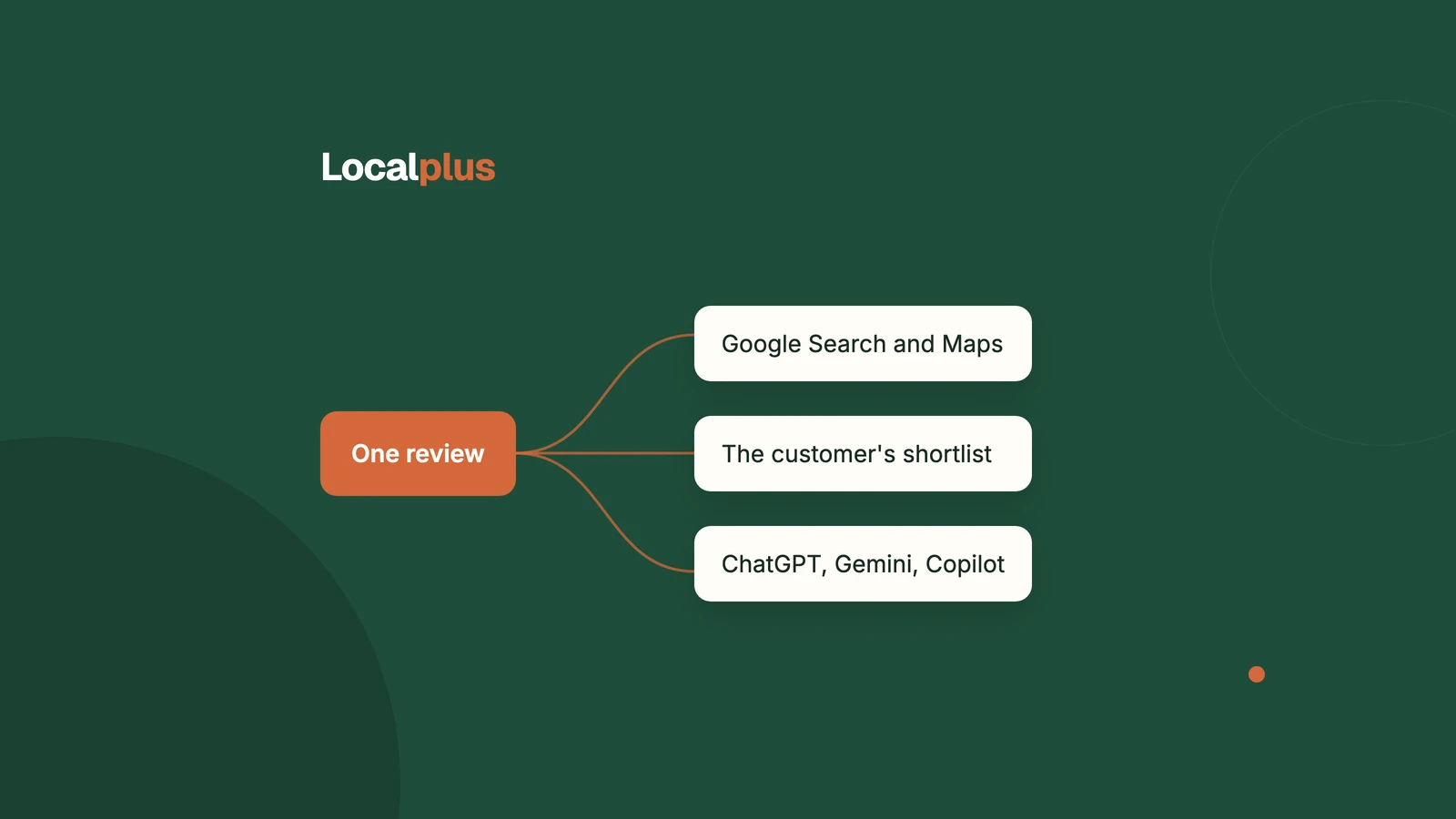
Your reviews work in three places at once: Google’s local results, the customer’s shortlist, and AI answers. Slip in one and the other two feel it, because all three are reading the same profile.
| Where the decision happens | What your reviews do there |
|---|---|
| Google Search and Maps | Count and score feed prominence, part of the trio Google says local ranking runs on |
| The customer’s shortlist | Star average, volume, and freshness decide whether your number gets tapped or scrolled past |
| ChatGPT, Gemini, and Copilot | Review text supplies the evidence an AI leans on when it recommends a business by name |
On the ranking side, Google’s own guidance for improving local ranking counts reviews and ratings among the signals that can help you show up, and “can” is doing honest work in that sentence: nothing about rankings is ever promised. The full relevance, distance, and prominence picture lives in our rundown of where Google rankings and AI answers really come from. The short version is that reviews are one of the few ranking inputs you can genuinely work at every single week.
At the shortlist stage the numbers get loud. In BrightLocal’s Local Consumer Review Survey 2026, published February 2026, 41% of consumers said they always read reviews when browsing for businesses, and 68% will now only use a business rated four stars or better, up from 55% a year earlier. Freshness has become its own filter: 74% want reviews written within the last three months. A wall of five-star praise from two summers ago clears none of those bars.
The newest reader of your reviews is not a person. The same survey found the share of consumers using ChatGPT and other generative AI tools for local business recommendations jumped from 6% to 45% in one year, making AI the third most popular source of recommendations behind Google and Facebook. And when an assistant explains who to call, the words your customers wrote are the richest description of your business those tools will ever find.
Why Do Reviews Matter Even More for Contractors?
Because a contractor asks for the biggest leap of faith in local commerce: letting a stranger into the house for expensive work that cannot be returned. Reviews are most of the evidence a homeowner gets before deciding.
A plumber, an HVAC tech, a roofer, or a remodeler is not selling a lunch someone can shrug off. The jobs are infrequent, the invoices are large, and the buyer usually cannot judge the quality until something leaks or fails. So homeowners do the rational thing and read what other homeowners lived through. Reviews that mention the crew arriving on time, the final bill matching the quote, and the site left clean answer the exact fears that stall a signature.
Three mechanics tilt the field further for the trades:
- Job details become searchable text. Reviews that name the service and the neighborhood feed the text Google and AI systems match against, one reason review depth features so heavily in AI SEO for home services.
- Local Services Ads read your reviews too. Google’s help page on ad rankings lists your rating and number of reviews among the profile-quality factors in the ad auction, and stronger profiles can rank higher and pay less per lead. Thin reviews quietly tax your ad budget.
- Seasonal work punishes stale profiles. With 74% of consumers in that BrightLocal survey wanting reviews from the last three months, an AC company judged in July on reviews from February is running uphill. Busy season is harvest season for reviews, not the excuse to skip asking.
How Do You Ask for Reviews So People Actually Leave One?
Treat the request as the final step of the job, made by the person who did the work, while the result is still fresh. Asking is not marketing bolted on afterward. It is part of the service, and customers respond when it is handled that way.
The data backs this up. In BrightLocal’s 2026 survey, 78% of consumers had been asked for a review in the past year, 83% of those asked went on to leave one, and the share who say they will always write one when asked rose from 16% to 28% in a single year. People are not tired of being asked. They are tired of being asked badly.
What a good ask looks like:
- Ask everyone you served. Not a hand-picked list of the delighted. Filtering who gets the request breaks Google’s rules, covered below, and quietly edits your reputation into fiction.
- Ask at the finish line. The moment the heat comes back on, or the invoice is settled, beats a reminder email three weeks later when the relief has faded.
- Have the person who did the work ask. “It genuinely helps us if you share how the install went” lands better from the tech who crawled under the house than from a noreply address.
- Make it one tap. A direct review link by text, or a QR code on the invoice. Every extra step sheds finished reviews.
- Follow up once. A single nudge a few days later is service. Five nudges is spam.
- Never script it. Telling customers what to write, or which services and towns to mention, crosses into policy trouble.
The job is not finished when the review lands, either. The same survey found 89% of consumers expect owners to respond to reviews, 80% say they are likely to use a business that answers all of them, and half are put off by canned, copy-paste replies. Short, specific answers, hardest ones first.
If the asking, the follow-ups, and the replies keep sliding off the end of your week, that loop is exactly what our reputation management service runs for local businesses: every customer asked, every review answered.
What Should You Never Do to Get Reviews?
Never pay for them, never filter who gets asked, and never write them yourself. Google’s rules are blunt on all three, and the penalties now appear where your customers can see them.
Google’s content policy for Maps, checked July 2026, rests on one sentence: “Contributions to Google Maps should reflect a genuine experience at a place or business”. Everything on the banned list falls out of it:
- No incentives. Discounts, gift cards, or a free service in exchange for a review are against policy. So is paying to make a negative review disappear.
- No gating. Sending the Google link only to customers you expect to be kind, while unhappy ones get routed to a private feedback form, is precisely the selective asking the policy prohibits.
- No inside jobs. Reviews from your own staff or family, or swapped five-star pacts with another shop, fall under conflict of interest.
- No buying. Purchased reviews are the fast lane to the ugliest outcome on this page.
The enforcement grew teeth. Google now documents business-side penalties for fake engagement: a profile can be stopped from receiving new reviews for a period, its existing reviews can be pulled from view, and Google can pin a notice on the listing telling customers it removed fake reviews from it. That last one is a warning sign on your digital front door, hung there by Google.
The honest lever, when a review genuinely breaks these rules, is to flag it against the policy. Only violations qualify. A one-star from a real customer having a real bad day is feedback, not a violation, and a calm public reply usually does more for you than removal ever could. When a review does cross the line, getting a policy-violating Google review removed is its own process with its own standards of evidence.
The Long Game: Why Your Review Profile Compounds
A review profile is the one marketing asset a local business truly owns. Ads stop selling the moment the budget stops. A review keeps selling for years, to people you will never meet, on surfaces you do not control.
That is the fullest answer to why reviews matter for local businesses. Each honest review is a permanent public answer to the question every future customer quietly asks: what happens after I hand these people my money? Stack up a few hundred of those and you hold something a competitor cannot buy at any price, because the only way to build it is to do good work and ask, job after job, year after year.
Want to know where your reviews stand today, count, score, freshness, and whether ChatGPT, Gemini, and Copilot mention your business when locals ask? Book a free local business audit and we will go through it with you live on the call, no charge and no strings.
Isaac founded Localplus to help local businesses in the US, UK & Canada get found in AI searches like ChatGPT, Gemini and Copilot. He's been working in the SEO space for over 15 years.